
Prescribing authority belongs to people, not to practices. Here is what that means from the day you sign a letter of intent to the first 90 days after closing
Most guides to selling a psychiatry practice discuss price, buyers and structure. Few explain what happens to prescribing, even though prescribing is the clinical core of the work. A patient on a stimulant or a benzodiazepine cannot simply wait a few weeks while paperwork catches up, and a buyer who has not planned for this will find out quickly. Understanding psychiatry practice DEA registration helps you avoid gaps in patient care and compliance problems that frighten buyers.
One principle drives everything below: prescribing authority and controlled substance registrations attach to individual practitioners and locations, not to the business as a whole. Selling the company does not hand the buyer your authority to prescribe, which is why psychiatry practice DEA registration deserves its own plan. The details differ by state, by role and by deal structure, so treat this as a planning framework and confirm specifics with a healthcare regulatory attorney.
Psychiatry Practice DEA Registration: The Core Idea
In general terms:
- A federal DEA registration is issued to a practitioner, for a particular business address, and is not simply transferred to another person.
- Many states require their own controlled substance registration or license, which may follow similar logic.
- Each prescriber uses their own credentials, including access to the state prescription monitoring program.
- A change of address or ownership may require updates to registrations, and new prescribers need their own.
If you will keep prescribing after the sale, your registrations may only need updating. If you are leaving, the people who will treat your patients need their own authority in place before they write their first prescription. Planning for that gap is the heart of the work.
Psychiatry Practice DEA Registration Timeline Overview
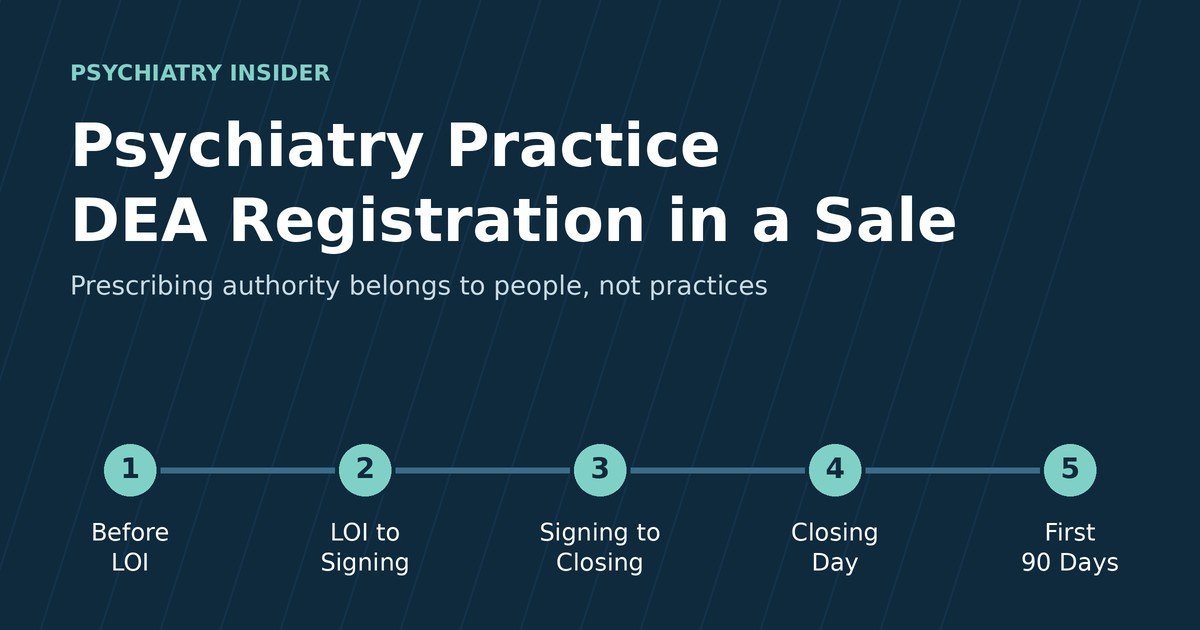
Five stages to plan for: before the letter of intent, letter of intent to signing, signing to closing, closing day and the first 90 days. The compliance focus moves from knowing what you hold, to answering buyer questions, to filing changes, to confirming every prescriber has valid authority, to stabilizing afterward.
Stage 1: Before the Letter of Intent
Start by understanding exactly what you hold. Make a simple register of:
- Each prescriber, with DEA and state registration details and expiration dates
- Each practice location where controlled substances are handled
- Whether any controlled substances are stored on site, and in what quantity
- Written policies on prescribing, refills, urine screening and monitoring
- Records of prescription monitoring checks, where required
This work serves two purposes. It prepares you for diligence, and it often reveals small housekeeping issues, such as an expired registration or an outdated address, that are much easier to fix now than during a deal. Our guide to psychiatry practice due diligence shows how these records fit into the wider buyer review.
Stage 2: Letter of Intent to Signing
During diligence, buyers will ask who will prescribe after closing and how continuity will be maintained. Plan your answers in advance.
Common questions include:
- Which prescribers are staying, and for how long?
- Will new prescribers be joining, and are their registrations in place?
- How many patients receive controlled substances, and how are they monitored?
- Has the practice ever faced a regulatory inquiry or an audit?
- Does any telehealth prescribing occur, and in which states?
That last point deserves attention. If your practice treats patients remotely, rules about prescribing controlled substances through telehealth have changed several times in recent years, and buyers will want to know exactly how you comply. Our article on telepsychiatry practice value explains how regulation affects what a telepsychiatry practice is worth.
Also decide, in writing, who is responsible for which compliance tasks between signing and closing. Vague responsibility is a common source of disputes.
Stage 3: Signing to Closing
This is the busiest stage. Typical tasks include:
- Registration updates. Filing any changes needed for address, ownership or new prescribers, with enough time to avoid a gap.
- Controlled substance inventory. If any are stored on site, agree on how they will be counted and handled at transfer, and follow the specific rules that apply. Many psychiatry practices keep little or none, which simplifies matters.
- Records. Agree how patient records and prescribing histories will transfer, consistent with privacy laws and your state’s record retention rules.
- Patient communication. Prepare a message that explains who will care for patients and how prescriptions will continue.
- Structure check. Confirm that the entity structure is consistent with corporate practice rules. Our overview of psychiatry MSO structures explains why the practice and the management company are separate.
Because registration changes can take time, some deals build in a delay, a conditional closing or a transition arrangement. Raise the timing issue early in negotiations, not at the end.
Stage 4: Closing Day
On closing day, the question is simple: does every person who will prescribe controlled substances have valid authority at this location, starting now? Check each prescriber individually. Confirm that:
- Registrations are current and listed at the correct address
- Access to the prescription monitoring program is working for each prescriber
- Any refill or bridging arrangements for patients are documented
- Staff know who to call with prescribing questions
If a gap exists, such as a new prescriber whose registration is pending, plan an interim arrangement in advance, for example an existing prescriber covering urgent needs, and follow all applicable rules. Never improvise around registration requirements.
Stage 5: The First 90 Days
The deal may be signed, but compliance risk is highest immediately afterward, when processes are changing. Over the first three months, pay attention to:
- Prescribing patterns. Look for unexpected changes after the transition.
- Record completeness. Ensure documentation remains consistent as staff and systems change.
- Monitoring checks. Confirm that required prescription monitoring checks continue.
- Patient retention. Track whether patients on controlled medications are continuing care or dropping out.
- Audit readiness. Keep the register from Stage 1 updated so you can respond quickly to any inquiry.
If you remain involved under a consulting or employment agreement, make sure the agreement is clear about what you are, and are not, responsible for. Our article on succession planning for a psychiatry practice shows how owners plan these handovers.
Who Needs to Be at the Table
Because the work crosses clinical, legal and financial lines, assemble the right people early. A practical team usually includes:
- A healthcare regulatory attorney, who confirms registration, licensing and entity questions
- The medical director or lead prescriber, who understands day-to-day prescribing workflows
- The practice administrator, who keeps the register of registrations and records current
- Your accountant, who ensures any inventory and revenue effects are handled correctly
- An advisor, who keeps the compliance timeline aligned with negotiations
Assign a single person to own the master timeline for psychiatry practice DEA registration and every related filing. When several people each hold part of the picture, items slip, and a missed registration date is exactly the type of error that delays closing.
What Buyers Usually Want to See
Buyers cannot assess what you do not show them. A short compliance binder, prepared before diligence begins, tends to build confidence quickly. It might include the register of prescribers and registrations, written prescribing and monitoring policies, a summary of any audits or inquiries and how they were resolved, and a plain-language description of how controlled medications are managed in the practice.
The aim is not to show perfection, since every practice has small issues. The aim is to show that you know where your risks are and manage them deliberately. That impression often matters as much as any single document, and it supports a smoother conversation about price and terms. Our overview of psychiatry practice valuation explains how perceived risk feeds into what buyers are willing to pay.
Common Mistakes
- Assuming registrations travel with the sale. They generally do not.
- Leaving the filing work until after signing. Delays leave patients exposed.
- Ignoring telehealth. Remote prescribing carries its own rules, and buyers focus on it.
- Poor records. Gaps in documentation reduce buyer confidence and may affect price.
- No communication plan. Patients who are surprised by a change in their prescriber are more likely to leave.
Protecting Patients From Gaps
The most important measure of a successful transition is that no patient loses access to medication they depend on. Consider a simple continuity checklist: identify patients with upcoming refills near the closing date, make sure each has a named prescriber, and confirm how urgent requests will be handled in the first week. Share the plan with staff so the front desk gives patients consistent answers.
Clear, calm communication reduces anxiety and calls. When patients know who to contact and what to expect, they are far more likely to stay with the practice, which also supports the retention a buyer is counting on.
Working With Advisors
Regulatory planning should sit alongside valuation and negotiation, not trail behind them. An advisory team with healthcare experience can help you sequence the work so that compliance items do not delay closing. Olympic M&A, for example, works with psychiatry practices and describes a healthcare-focused advisory team that supports owners through the sale process. Whoever you hire, your regulatory attorney should review every filing and every patient communication before it goes out.
Closing Thoughts on Psychiatry Practice DEA Registration
Selling a psychiatry practice involves more than price. It requires a plan for how prescribing will continue safely, lawfully and without interruption for people who depend on it. Start with your own register, plan the timeline with your attorney and keep patients at the center of every decision. For more on where to start, see our overview of preparing your psychiatry practice for sale and our guide to how to sell a psychiatry practice.
This article is general information and not legal or medical advice. DEA, state and telehealth prescribing rules change and vary by jurisdiction. Consult a qualified healthcare regulatory attorney before acting.
About Psychiatry Insider
Psychiatry Insider publishes practical, owner-focused guidance for people planning a sale or transition. Visit psychiatryinsider.com for more guides.